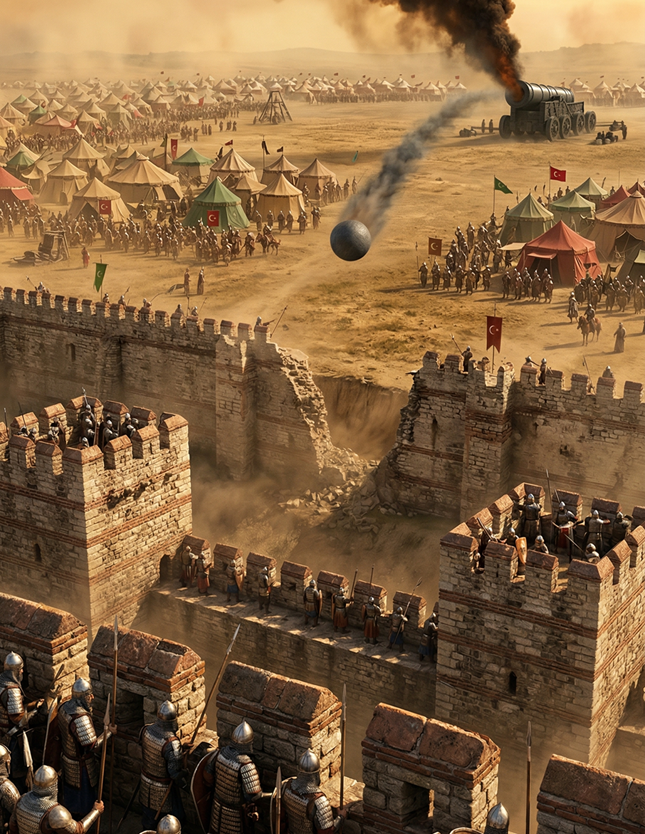
Witness the Unthinkable: The 1453 Breach of Constantinople's Mighty Walls
Step back to 1453, to the formidable Theodosian Land Walls in Ayvansaray, where a millennium-old empire met its dramatic end. This immersive audio tour will guide you along the very defenses that stood unbreakable for centuries, unveiling the terror, the desperation, and the sheer audacity of the final siege. Decode the blood-soaked climax that forever reshaped history.
🎧 20-Second Audio Guide Preview
“Stand before the formidable Theodosian Walls. For 1,000 years, they were unbreakable. Look closely at the crumbling sections, battered by Orban's monstrous cannons that changed warfare forever. Now, find the small, hidden Kerkoporta Gate. This single, unlocked door led to the greatest military blunder in history, destroying an empire. What secret lies within?”
🗺️ Interactive Walking Route Map
Tap any numbered stop pin to preview its location & walking directions
We stand where Byzantium’s fate was sealed, along the colossal Theodosian Land Walls, an engineering marvel from the 5th Century AD. Imagine stripping away the modern city to reveal a terrifying 20-meter dry moat, the first hurdle for any attacker. Beyond lay an outer wall, and then the massive, 12-meter-high inner stone wall – a triple-layered defense that for over 1,000 years proved impenetrable to every army on Earth. Integrated directly into these formidable defenses were critical structures like the Dungeons of Anemas, a terrifying 12th-century political prison, and the majestic Palace of the Porphyrogenitus, the last imperial residence, from which Emperor Constantine XI watched the siege unfold.
The Apocalyptic Siege: Cannons, Courage, and Collapse
April 1453 marked a terrifying new chapter for the Theodosian Walls. From the bustling modern neighborhood stretching before us, envision the endless encampment of 100,000 Ottoman soldiers and the monstrous 27-foot bronze bombard crafted by the engineer Orban. These super-cannons fired massive stone balls, battering these invincible walls into the crumbling ruins we see today, fundamentally changing the future of warfare. Amidst the chaos, the brilliant Genoese commander Giustiniani held the defenses. When shrapnel shattered his chest, his retreat led to a catastrophic collapse of Byzantine morale. Emperor Constantine XI, seeing all was lost, famously ripped off his imperial regalia and charged into the overwhelming Ottoman tide.
The Fatal Breach: An Empire's Unforeseen End
The final, blood-soaked climax on May 29, 1453, hinged on an unthinkable blunder: the Kerkoporta Gate. This small, hidden postern gate, used for counter-attacks, was accidentally left unlocked. A mere 50 Ottoman soldiers slipped through, raising their flag and triggering an empire-ending panic. This act, coupled with the suicidal bravery of Ulubatlı Hasan, who planted the Ottoman flag despite being riddled with 27 arrows, inspired the final surge. At the magnificent Edirnekapı gate, Sultan Mehmed II made his triumphant entry. This moment, while appearing sudden, was preceded by the 4th Crusade's devastating blow in 1204 and the miraculous Ottoman recovery after Timur's 1402 decimation, setting the stage for history's dramatic turning point.
Ready to Explore Istanbul?
Download the Istanbul Smart Guide now and transform your travel experience
Conclude at the waterfront where defenders woke up to the nightmare of Ottoman ships inside their protected harbor.
Frequently Asked Questions
What is the historical significance of the Theodosian Walls in Istanbul?
The Theodosian Walls, built in the 5th Century AD, represent an unparalleled defensive masterpiece. For 1,000 years, their triple-layered design of a dry moat, outer wall, and massive inner wall made Constantinople impenetrable, safeguarding the Byzantine Empire.
What was the role of the Kerkoporta Gate in the fall of Constantinople?
The Kerkoporta Gate was a small, hidden postern gate accidentally left unlocked during the final siege on May 29, 1453. Its breach by a small band of Ottoman soldiers triggered panic among defenders, leading directly to the city's collapse.
Can I visit the Dungeons of Anemas or the Palace of the Porphyrogenitus on this tour?
This tour guides you to the exterior of both the Dungeons of Anemas (a 12th-century political prison) and the Palace of the Porphyrogenitus. The Dungeons are not accessible for entry, but you can examine the exterior of these historic structures built into the walls.
How does the Istanbul Audio Guide enhance my experience of the 1453 Walls tour?
Our audio guide provides rich historical narration, decoding the stories behind each site you visit along the Theodosian Walls. It uses spatial cues to bring the apocalyptic 1453 siege to life, from Orban's cannons to the exact breach points, enhancing your understanding and immersion.