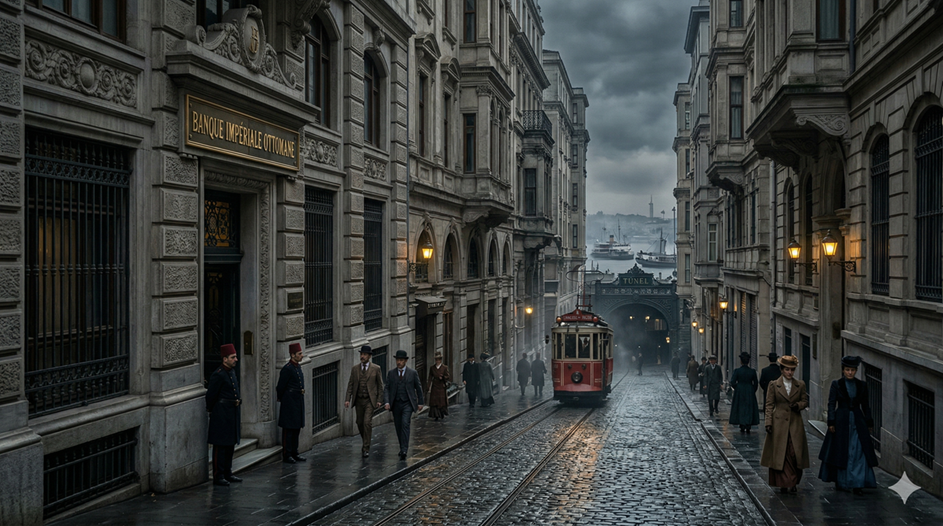
Bankalar Caddesi: Walk the Imperial Wall Street of the East
Step onto Bankalar Caddesi, Istanbul's historic 'Wall Street of the East.' Here, along these very cobblestones, the fate of the Ottoman Empire intertwined with European financial might. This street witnessed the rise of opulent banking houses, the lives of powerful financiers, and dramatic events like the 1896 Ottoman Bank takeover. Prepare to uncover a story of wealth, debt, and daring revolution.
🎧 20-Second Audio Guide Preview
“Stand on Bankalar Caddesi, Istanbul's 'Wall Street of the East.' Look closely at the colossal Imperial Ottoman Bank. This fortress-like building symbolized European financial control over a vast empire. Notice the intricate details, masking immense debt and political tension. What secrets do these stone walls still hold from the 1896 bank raid?”
🗺️ Interactive Walking Route Map
Tap any numbered stop pin to preview its location & walking directions
The Imperial Ottoman Bank: A Monument to Foreign Power
Our journey begins before the monumental Imperial Ottoman Bank, a structure completed in 1892 by the renowned architect Alexandre Vallaury. Despite its name, this colossal headquarters was a stark symbol of European financial imperialism, controlled entirely by British and French shareholders. It served as the ultimate vault for foreign powers, holding the immense debts of a faltering Ottoman Empire. Its fortress-like exterior, which you can admire today, did not merely house financial transactions; it represented a humiliating testament to the empire's economic dependence, a constant reminder of who truly held the purse strings in 19th-century Istanbul. This building embodies the era's complex power dynamics.
The Kamondo Legacy: Wealth, Power, and Revolution
Just a short walk from the bank, you’ll encounter the legacy of the Kamondo family, often dubbed the 'Rothschilds of the East.' This incredibly wealthy Levantine family, who funded the Ottoman Empire's involvement in the Crimean War, left behind the iconic Kamondo Stairs and grand palaces reflecting their insulated, European-style luxury. Their lavish balls and French-speaking circles highlighted a bubble of immense privilege, detached from the city's struggles. Yet, this opulence was shattered on August 26, 1896, when armed Armenian revolutionaries stormed the Imperial Ottoman Bank. They took 150 European staff hostage, threatening to detonate explosives to force European intervention against the massacres of Armenians. It was a desperate, bloody standoff that shook global finance.
Architectural Grandeur & Elite Commute: From Minerva Han to the Tünel
As we continue along Bankalar Caddesi, admire Minerva Han, built in 1913 for the Bank of Athens. Notice the intricate stone carvings and the watchful gaze of the goddess Minerva; this extravagant Art Nouveau architecture was no accident. Its opulent design aimed to project absolute stability and power, a deliberate effort to reassure nervous European investors pouring capital into the 'Sick Man of Europe.' Our tour concludes at the historic Tünel Entrance, the world's second-oldest underground urban railway, opened in 1875. This revolutionary transport was explicitly financed for the wealthy European bankers and merchants of Bankalar Caddesi, allowing them a comfortable, mud-free commute up the steep hill to their lavish homes and embassies in Pera, epitomizing their insulated world.
Ready to Explore Istanbul?
Download the Istanbul Smart Guide now and transform your travel experience
Conclude at the historic underground railway explicitly built for wealthy bankers to commute in comfort.
Frequently Asked Questions
What makes Bankalar Caddesi historically significant?
Bankalar Caddesi was Istanbul's "Wall Street of the East," where Ottoman finance and European power converged. It was central to the empire's economic history, witnessing the rise of influential banking families and the dramatic 1896 Imperial Ottoman Bank raid.
Who were the Kamondo family and why are they important?
The Kamondo family were incredibly wealthy Levantine bankers, known as the "Rothschilds of the East." They financed the Ottoman Empire's Crimean War involvement and their lavish lifestyle is reflected in the Kamondo Stairs and palaces nearby.
What was the 1896 Ottoman Bank raid?
On August 26, 1896, Armenian revolutionaries stormed the Imperial Ottoman Bank, taking hostages and threatening detonation to force European intervention against Armenian massacres. It was a violent event that captured international attention.
How does this audio guide enhance my visit to Bankalar Caddesi?
Our audio guide provides historical context and vivid storytelling for each stop, from the Imperial Ottoman Bank to the Kamondo Stairs and the Tünel. It deepens your understanding of Istanbul's financial past and the dramatic events that unfolded on these streets.