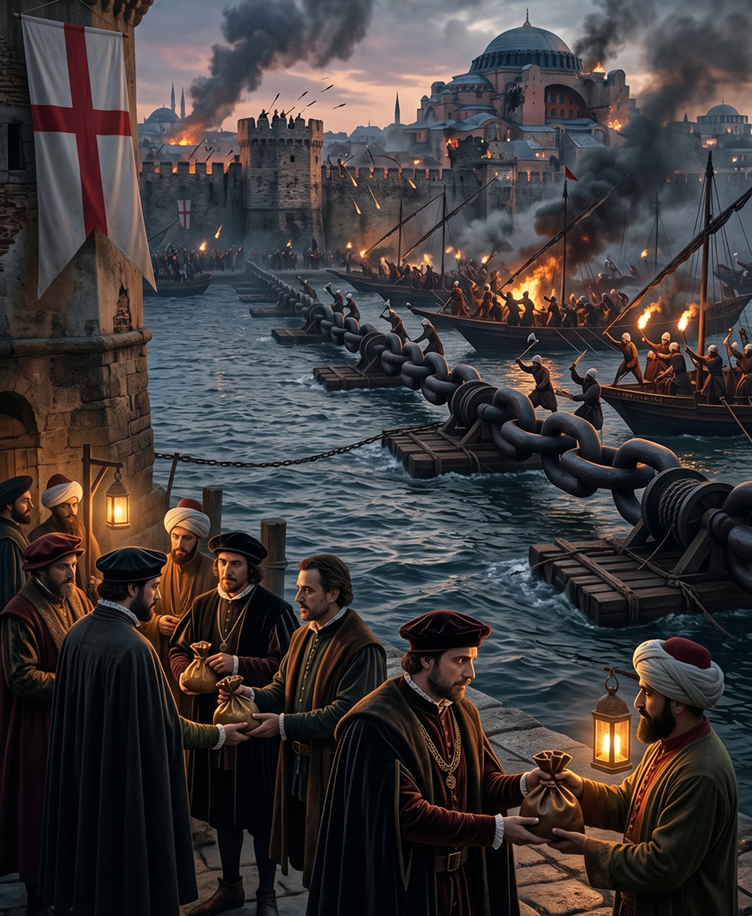
The Price of Treachery: Galata's Deadly Deal with the Enemy
Step into the shadows of Karaköy and Galata, where empires clashed and allegiances shifted like the Golden Horn's tides. This district, once a formidable Genoese colony, holds the secrets of a fragile alliance that ultimately doomed Constantinople. Discover how Latin merchants, driven by insatiable greed, carved out an independent republic on Byzantium's doorstep, ready to betray their Christian neighbors for gold and power.
🎧 20-Second Audio Guide Preview
“Stand now where the Great Chain once stretched. Imagine it, a colossal iron defense, blocking enemy fleets. Look closely at the remnants of the Genoese fortress, the key to Constantinople's front door. These merchants held immense power. Did their 'neutrality' hide a deeper betrayal during the final siege?”
🗺️ Interactive Walking Route Map
Tap any numbered stop pin to preview its location & walking directions
The Great Chain & Latin Rivalry: A Double-Edged Defense
Our journey begins at the legendary Great Chain, a marvel of medieval engineering. Imagine a massive iron chain, supported by wooden rafts, pulled taut across the Golden Horn from the Genoese Kastellion (now Yeraltı Camii) to the imperial Eugenius Tower. This formidable barrier was designed to block enemy fleets from Constantinople’s harbor. Yet, it embodied a dangerous paradox: its control by the Genoese colony of Galata granted these foreign merchants immense, almost extortionate leverage over the Byzantine Emperor. This fragile defense was further weakened by bitter rivalries, as Venetian and Genoese merchants, obsessed with trade monopolies, frequently engaged in naval battles within the harbor, often burning each other’s ships and leaving the city caught in the crossfire of their extreme greed, rather than uniting against common foes.
Galata's Autonomous Walls: A City Within a City
After assisting the Byzantines in reclaiming their throne, the Genoese were granted the strategic district of Galata. However, their gratitude was short-lived. Aggressively defying existing treaties, they began secretly constructing formidable stone walls and deep moats around their colony. The once-powerful Byzantine Emperors, now impoverished and politically weakened, were powerless to halt this brazen act. This created an independent, hostile fortress right on Constantinople's doorstep. From the Palazzo del Comune, the Podestà, Galata's Genoese governor, ruled with pragmatic cunning. During the 1453 Ottoman siege, Galata declared 'neutrality,' a facade behind which their soldiers aided Byzantium by night, while their merchants supplied the Ottoman army by day, ensuring their survival and prosperity no matter the outcome.
The Siege of 1453: Treachery and Tactical Genius
The ultimate test of Galata’s loyalties arrived on April 22, 1453. With the Great Chain blocking the Golden Horn, Sultan Mehmed II conceived an audacious plan: he ordered 70 warships to be dragged overland, greased on wooden logs, right behind Galata's walls, bypassing the chain entirely. The Genoese watched this impossible feat from their tower, yet did nothing, unwilling to jeopardize their lucrative trading rights to save the Eastern Roman Empire. On the very day Constantinople fell, May 29, 1453, the Genoese Podestà marched out of Galata's gates to hand the keys of the colony directly to Sultan Mehmed II. This act of strategic surrender guaranteed their continued trading privileges, proving that for Galata's merchants, gold was indeed a stronger fortress than stone.
Ready to Explore Istanbul?
Download the Istanbul Smart Guide now and transform your travel experience
Conclude at the waterfront, proving that gold was a stronger fortress than stone.
Frequently Asked Questions
What was the significance of the Great Chain in Constantinople's defense?
The Great Chain was a crucial defensive barrier, physically blocking enemy fleets from entering the Golden Horn. However, its control by the Genoese in Galata gave them immense political and economic leverage over the Byzantine Empire.
How did the Genoese colony of Galata maintain its neutrality during the 1453 siege?
Galata claimed neutrality, a strategy that allowed its soldiers to secretly assist Byzantine defenders at night, while its merchants openly supplied the Ottoman army by day. This dual approach ensured their survival and economic stability after the conquest.
Where can I see remnants of Galata's historical defenses mentioned in this audio tour?
You can visit the Yeraltı Camii, built over the Genoese Kastellion, which was one anchor point for the Great Chain. While the Galata Walls are mostly gone, their original path can still be traced within the district.
How does the Istanbul Audio Guide enhance my visit to Karaköy and Galata?
Our audio guide brings the dramatic history of Karaköy and Galata to life with immersive storytelling and precise navigational cues. It allows you to explore the sites of betrayal and strategic maneuvers at your own pace, providing deep historical context for every stop.