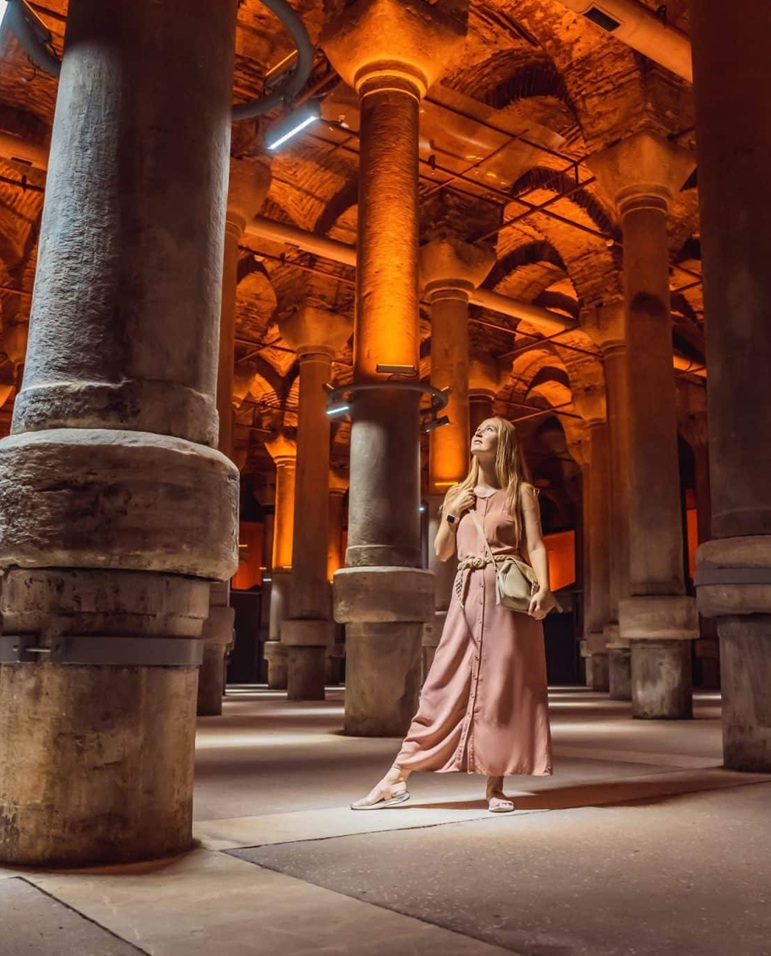
Descend into the Depths: Istanbul's Roman Engineering Marvel, the Basilica Cistern
Step back to 6th-century Constantinople and prepare to descend into an architectural wonder. Below the bustling streets of Istanbul lies the Basilica Cistern, a subterranean masterpiece of Roman engineering. Imagine a city under siege; its survival hinged on a hidden supply of water. This monumental vault guaranteed life, a testament to Byzantine ingenuity forged during Emperor Justinian I's reign.
🎧 20-Second Audio Guide Preview
“Stand before this ancient marvel. Look up at the immense cross-vaulted ceilings. Feel the cool air. This 6th-century vault held 80,000 cubic meters of water, vital for Constantinople's survival. Notice the recycled columns, including those unique Medusa bases. What other secrets does this submerged world hold?”
The Imperial Lifeline: Engineering for Survival
The Basilica Cistern, commissioned by Emperor Justinian I in 532 AD, stands as a testament to strategic Roman engineering. Constantinople, heavily fortified, still faced the critical challenge of water supply during sieges. This subterranean reservoir, designed to store a staggering 80,000 cubic meters of water, was a lifeline for the Great Palace, ensuring the city's endurance during months-long military blockades. Its ingenious cross-vaulted ceiling, constructed with Byzantine brickwork, masterfully distributes the immense weight of the basilica and city streets above, channeling pressure through 336 columns into the bedrock below, a marvel of structural integrity.
Aqueduct's Journey & Ancient Waterproofing Secrets
This vast cistern, devoid of natural springs, relied entirely on a sophisticated Roman hydraulic system. Water embarked on a 19-kilometer (12-mile) journey from the Belgrade Forest, guided by gravity along a precisely engineered slope, before traversing the colossal Valens Aqueduct. Upon reaching the cistern, preventing leakage was paramount. The massive 4-meter (13-foot) thick firebrick walls were meticulously coated with "Horasan mortar," an ancient, durable, and completely waterproof Roman cement. This specialized mixture of crushed terracotta, brick dust, and lime effectively sealed the 80,000 tons of water within its confines for centuries.
Among the Basilica Cistern's most captivating features are the enigmatic Medusa heads, often shrouded in myth. However, the true story is one of pragmatic Roman ingenuity. These massive stone heads were not placed for artistic or superstitious reasons, but rather for a purely structural purpose: leveling. The builders, needing additional columns for a specific corner, repurposed "spolia"—materials scavenged from older structures. The scavenged columns were simply too short to properly reach the vaulted ceiling. The Medusa heads provided the exact mathematical height required to bridge this gap, serving as robust, foundational leveling blocks, a brilliant example of efficient resourcefulness.
Ready to Explore Istanbul?
Download the Istanbul Smart Guide now and transform your travel experience
Follow these stops in the Istanbul Smart Guide mobile app with offline GPS & interactive AI.
1
Welcome to the Masterpiece
📍 Above ground, before the stairs.
A brief welcome and introduction to the tour.
2
The Imperial Need
📍 The entrance platform.
Why build this? The logistics of storing 80,000 cubic meters of water to survive a siege.
3
The Vaults and Arches
📍 Main walkway, prompting the user to look up at the ceiling.
The genius of Byzantine brickwork. How the cross-vaulted ceiling distributes the massive weight of the city above.
4
The Aqueduct Connection
📍 Midway along the path.
How the water actually got here from the Belgrade Forest, 20 kilometers away, via the Valens Aqueduct.
5
Waterproofing an Empire
📍 Near the Crying Column.
The chemistry of the ancient world: Explaining "Horasan mortar," the special pink, waterproof cement lining the walls.
6
Structural Recycling
📍 Medusa heads / back corner.
The engineering reality of the Medusa heads: They weren't placed for art; they were the exact mathematical height needed to level the columns.
Frequently Asked Questions
When was the Basilica Cistern built and for what primary purpose?
The Basilica Cistern was commissioned by Emperor Justinian I in 532 AD. Its primary purpose was to provide a massive, secure, and hidden water supply for Constantinople, especially the Great Palace, during prolonged sieges.
How did water get into the Basilica Cistern without natural springs?
Water was transported to the cistern from the Belgrade Forest, approximately 19 kilometers away. It flowed via an ancient Roman hydraulic system, utilizing gravity and crossing the impressive Valens Aqueduct bridge.
What is the historical truth behind the Medusa heads in the cistern?
Contrary to popular myths, the Medusa heads were placed for structural and practical reasons. They were repurposed "spolia" used as leveling blocks to make salvaged columns, which were slightly too short, reach the vaulted ceiling.
Can the Istanbul Audio Guide app enhance my visit to the Basilica Cistern?
Yes, the Istanbul Audio Guide app offers a comprehensive self-guided tour of the Basilica Cistern, providing historical insights, engineering details, and captivating stories for each significant feature, allowing you to explore at your own pace.